
In France, 1,582,214 hearing aids were sold in 2024, according to Snitem. The market has resumed slight growth after two years of stagnation, driven by the 100% Health scheme, which now accounts for the majority of sales. This progress masks a more contrasting reality: many hearing aid users do not make the most of their equipment, either because they did not ask the right questions initially or did not understand the constraints of follow-up care.
Class I or Class II: What the 100% Health basket really changes in choice
Hearing aids of Class I accounted for 60.1% of sales in volume in 2024, compared to 55% the previous year. This category, included in the 100% Health basket, guarantees zero out-of-pocket expenses for the insured, provided they have a responsible supplementary insurance. Class II models, which are more expensive, offer additional features whose real usefulness depends on the hearing profile and lifestyle.
The distinction is not just a price difference. A Class I device covers basic needs: appropriate amplification, reduction of surrounding noise, and at least three adjustment channels. Class II models often add Bluetooth connectivity, finer noise processing algorithms, or rechargeability.
For a person with moderate hearing loss and simple listening situations (face-to-face conversation, television), a Class I device may be sufficient. Platforms like akoitique.fr allow users to compare the technical characteristics of different ranges before visiting an audiologist.
A common mistake is to choose Class II by reflex, associating high price with superior quality. The relevant question is not “what is the best device” but “what functions are truly useful to me on a daily basis.”
Audiogram and listening situations: two data points that guide everything else
The audiogram identifies the affected frequencies and the degree of loss. A focus on high-frequency sounds creates a different discomfort than a general decrease in perceived volume. In the first case, the person hears but does not understand the words, especially in a noisy environment. In the second, sound is lacking everywhere.
This technical distinction conditions the type of device, the power of the receiver, and the choice of ear tip. A competent audiologist cross-references this data with actual listening situations: open space work, group outings, frequent phone calls, outdoor walks.
Situations that standard adjustments do not cover
Pre-recorded programs manage common environments well. However, certain situations pose persistent difficulties, even with a well-adjusted device:
- Conversations in a noisy restaurant, where the signal-to-noise ratio is unfavorable, remain a weak point for most ranges.
- Listening to live music requires frequency ranges that compression algorithms can distort.
- Video conference meetings combine audio latency, digital compression, and lack of lip reading, complicating comprehension even with a hearing aid.
Identifying these situations before purchase allows for targeted adjustments during the trial period, rather than discovering limitations afterward.
Renewal and follow-up: regulatory deadlines to know
Renewal is subject to a four-year period calculated from the date of issuance or billing of the old device. This point regularly generates confusion: the period does not start from the date of the prescription or the beginning of the trial period. An early renewal remains possible if the device is irreparable or has become unsuitable for the hearing condition, but under specific medical and administrative conditions.
Follow-up after fitting is an underestimated aspect. Initial adjustments are almost never final. The brain needs several weeks to readjust to sounds it had stopped processing. Field feedback varies on the adaptation period, but most audiologists plan between three and five adjustment appointments in the first year.
What the follow-up package really covers
The price of a hearing aid includes a follow-up package over four years. This package covers adjustment appointments, cleaning, minor repairs, and regular hearing checks. In practice, the frequency and quality of this follow-up vary from one center to another. Checking what the package concretely includes before signing avoids unpleasant surprises.

In-ear or behind-the-ear: a choice dictated by morphology
In-ear hearing aids are appealing due to their discretion. They fit into the ear canal and remain almost invisible. This shape is suitable for mild to moderate losses, provided the ear canal is wide enough to accommodate the electronics and allow for proper ventilation.
Micro-behind-the-ear (or behind-the-ear with external receiver) is the most prescribed shape. Their versatility covers the majority of hearing loss profiles. They adapt better to people wearing glasses or masks, and their size allows for the integration of more durable rechargeable batteries.
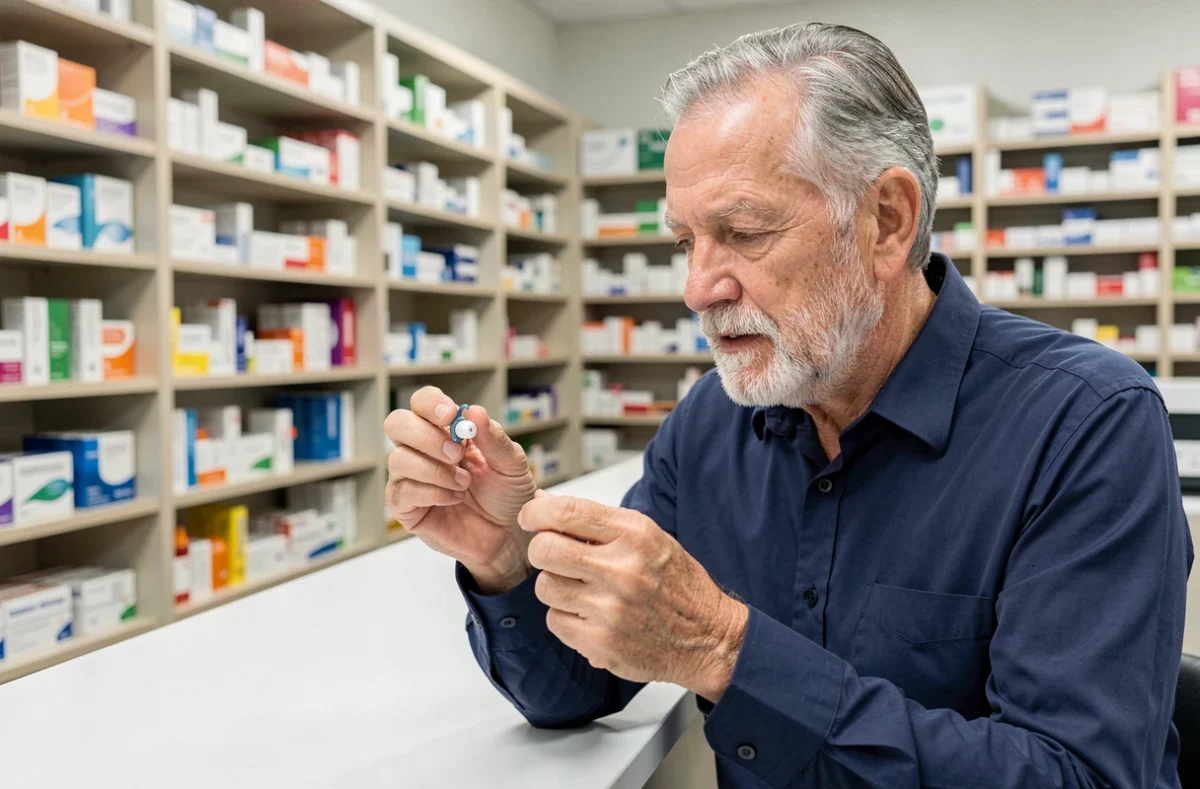
Manual dexterity also comes into play. A small in-ear device may be difficult to handle for someone with arthritis or tremors. This criterion, rarely mentioned in online comparisons, nevertheless conditions daily comfort of use.
Trial period for hearing aids: what to demand
Regulations provide for a trial period before final purchase. This phase allows testing the device in real-life conditions, not just in the silence of an audiometric booth. It is during the trial that adjustments should be refined, not afterward.
Some concrete points to monitor during this period:
- Test the device in at least three different environments (quiet home, busy street, social setting) and note any difficulties encountered.
- Check physical comfort after several hours of continuous wear, particularly the absence of irritation in the canal.
- Evaluate battery life over a full day of use, including recharging if the device is rechargeable.
- Request an adjustment as soon as discomfort or annoyance persists, without waiting until the end of the trial.
A poorly adjusted device during the trial period often ends up in a drawer. The available data does not allow for precise quantification of the abandonment rate, but associations of hard-of-hearing individuals regularly report this phenomenon as a recurring issue in the hearing aid journey in France.