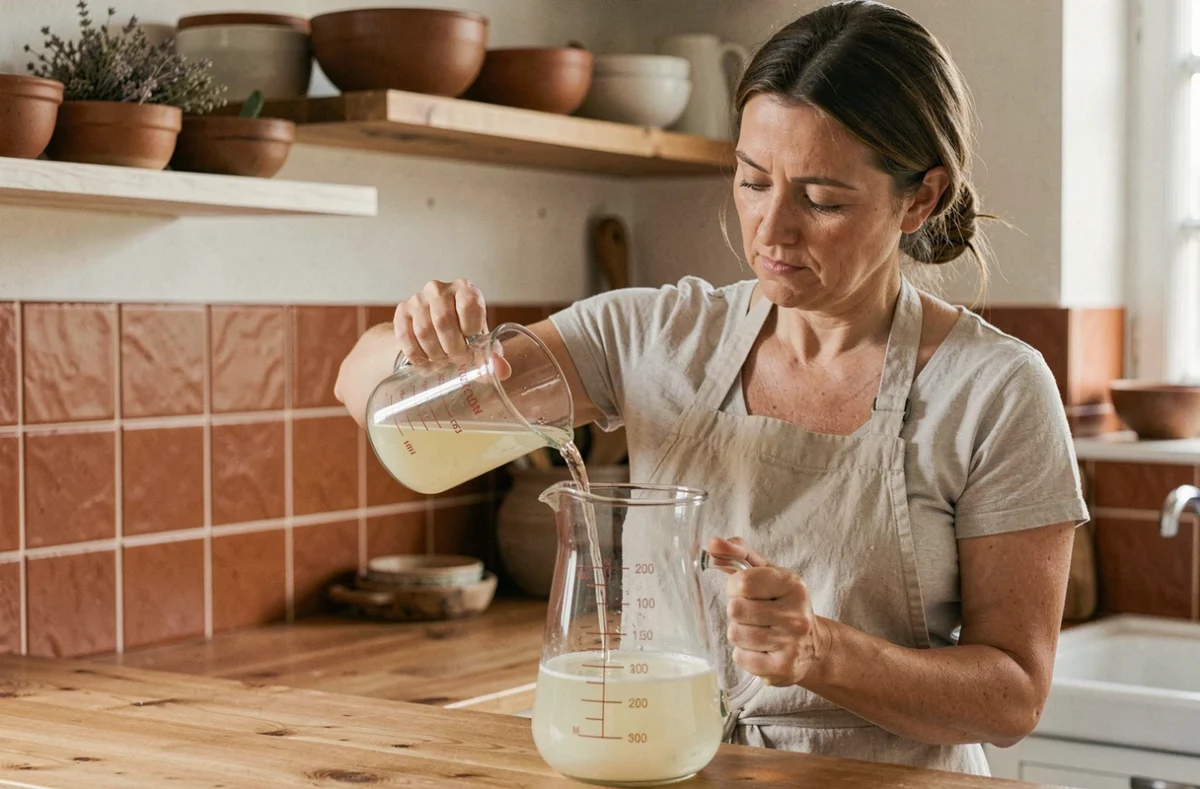
Converting 300 ml to liters involves dividing by 1,000: the result is 0.3 liters, or 30 centiliters. This arithmetic operation may seem trivial, but in cooking, the reliability of the result depends less on the calculation than on how the liquid is measured. A misread measuring cup or a non-standardized mug is enough to skew a recipe.
Meniscus and parallax: what really skews the measurement of 300 ml
The formula is simple, but the act of measuring is less so. When a liquid is poured into a graduated container, its surface forms a curve called a meniscus. For water, milk, or broth, this meniscus is concave: the liquid slightly climbs up the sides.
The correct reading is taken at the lowest point of this curve, with the eyes positioned exactly at the height of the graduation. If viewed from above, the volume is overestimated. From below, it is underestimated. The NIST recommends this method to reduce parallax error, a reflex particularly useful for small volumes.
To understand what 300 ml corresponds to in liters in practice, one must therefore combine the calculation with a precise reading gesture. Without this, the conversion remains theoretical.
Tests reported by Handmadelytics in 2026 indicate that domestic measuring cups show significant discrepancies from the indicated volume, unlike laboratory volumetric glassware. A quality graduated container, placed on a stable work surface, remains the best ally for measuring 300 ml without surprises.
Conversion ml to liters and centiliters: the logic of the metric system
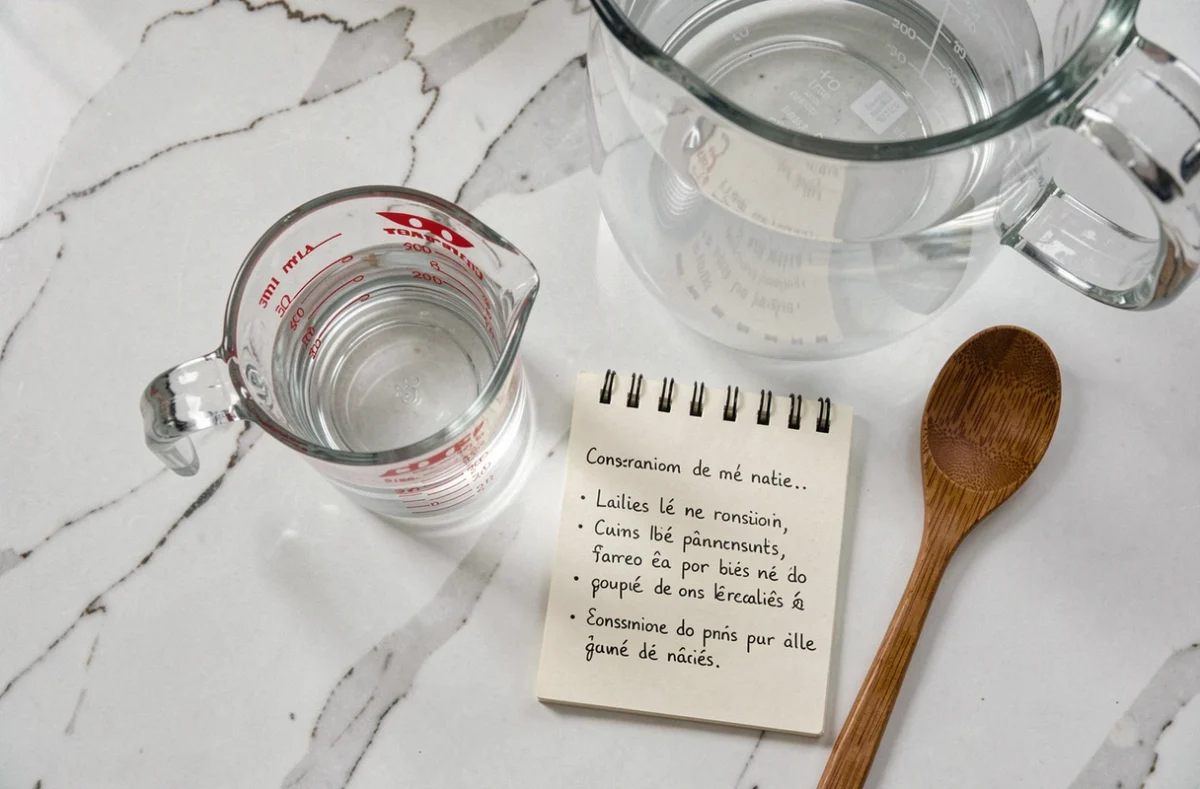
The metric system is based on multiples of 10. One liter contains 1,000 milliliters, and one centiliter contains 10. To convert from milliliters to liters, divide by 1,000. To convert from milliliters to centiliters, divide by 10.
Applied to the conversion of 300 ml:
- 300 ml divided by 1,000 gives 0.3 liters, the value to remember for recipes expressed in liters.
- 300 ml divided by 10 gives 30 centiliters, a common unit on French packaging (cream cartons, beer bottles).
- 300 ml also corresponds to 3 deciliters, a unit still used in some older European cookbooks.
This consistency makes metric conversions reliable, provided they are not confused with Anglo-Saxon measurements.
American cup and 300 ml: a misleading equivalence
Anglo-Saxon recipes use the “cup” as a volume unit. The problem is that there is not a single definition of a cup. The standard American cup corresponds to about 236.6 ml. U.S. nutritional labeling rules (21 CFR § 101.9) use 240 ml. In countries using the metric system, a cup often equals 250 ml.
Therefore, 300 ml does not correspond to any of these standard cups. Converting 300 ml to “one cup and a quarter” only makes sense if one knows which cup the recipe uses. An Australian recipe and an American recipe both stating “1¼ cup” do not require the same actual volume.
The safest reflex is to convert everything to milliliters before measuring. If the recipe indicates cups, first check the origin of the book or website, then convert using the corresponding cup value.
Conversion of 300 ml to weight: why the result changes depending on the ingredient
In cooking, volume and weight are often confused. For pure water, 300 ml weighs approximately 300 grams, as its density is close to 1. This equivalence does not hold for any other common ingredient.
Flour, for example, is much lighter at equal volume: 300 ml of flour weighs significantly less than 300 grams. Conversely, 300 ml of honey weighs more, as honey is denser than water. The density of each ingredient alters the relationship between volume and weight.
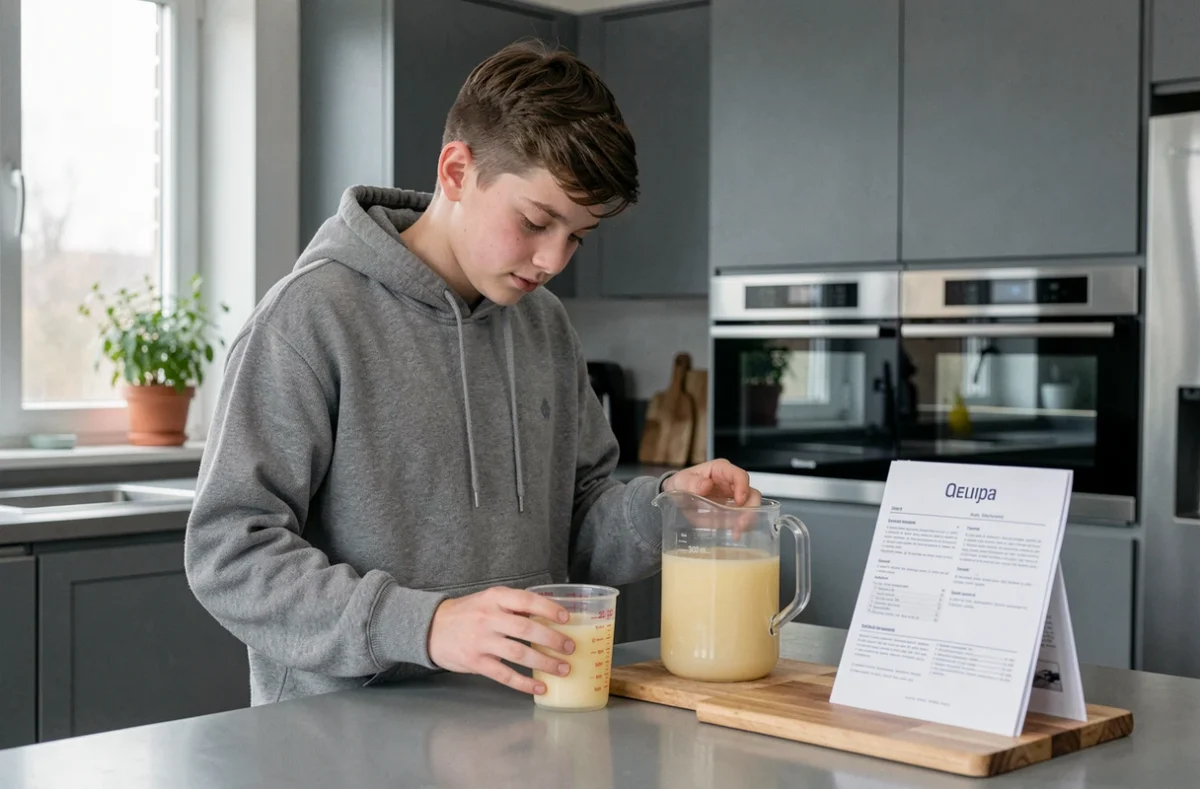
When a recipe calls for 300 ml of milk, pouring the milk into a graduated measuring cup is the right approach. When it calls for 300 g of milk, the scale takes precedence. Interchanging the two gives a different result, even if the difference is small for milk (whose density is slightly higher than that of water).
When to use the measuring cup and when to use the scale
For liquids (water, milk, oil, broth), the graduated measuring cup in milliliters is the appropriate tool. For solids and powders (flour, sugar, cocoa), the scale offers superior accuracy, as settling in the container can unpredictably alter the volume.
A readable measuring cup and a digital scale cover all measurement needs for home recipes. Measuring spoons (about 15 ml for a tablespoon, about 5 ml for a teaspoon) complement the setup for small quantities.
Memorizing the conversion of 300 ml without a chart
Rather than consulting a chart for every recipe, remembering a simple reference is enough. A standard table glass typically holds between 200 and 250 ml. Thus, 300 ml is a little more than a large full glass, or two small glasses.
Practically speaking, 300 ml fills a medium bowl about two-thirds full. This visual reference allows for a quick check to see if the amount poured into the measuring cup seems consistent, even before reading the graduation.
The other anchor point is the relationship with the liter: 300 ml is just under a third of a one-liter bottle. Visualizing this level in a familiar bottle helps detect a gross measurement error.
The conversion of 300 ml to liters poses no mathematical difficulty. What separates a reliable measurement from an approximate one is the choice of container and the reading technique. A good measuring cup, eyes at the height of the graduation, and checking the origin of the units in foreign recipes eliminate nearly all errors.