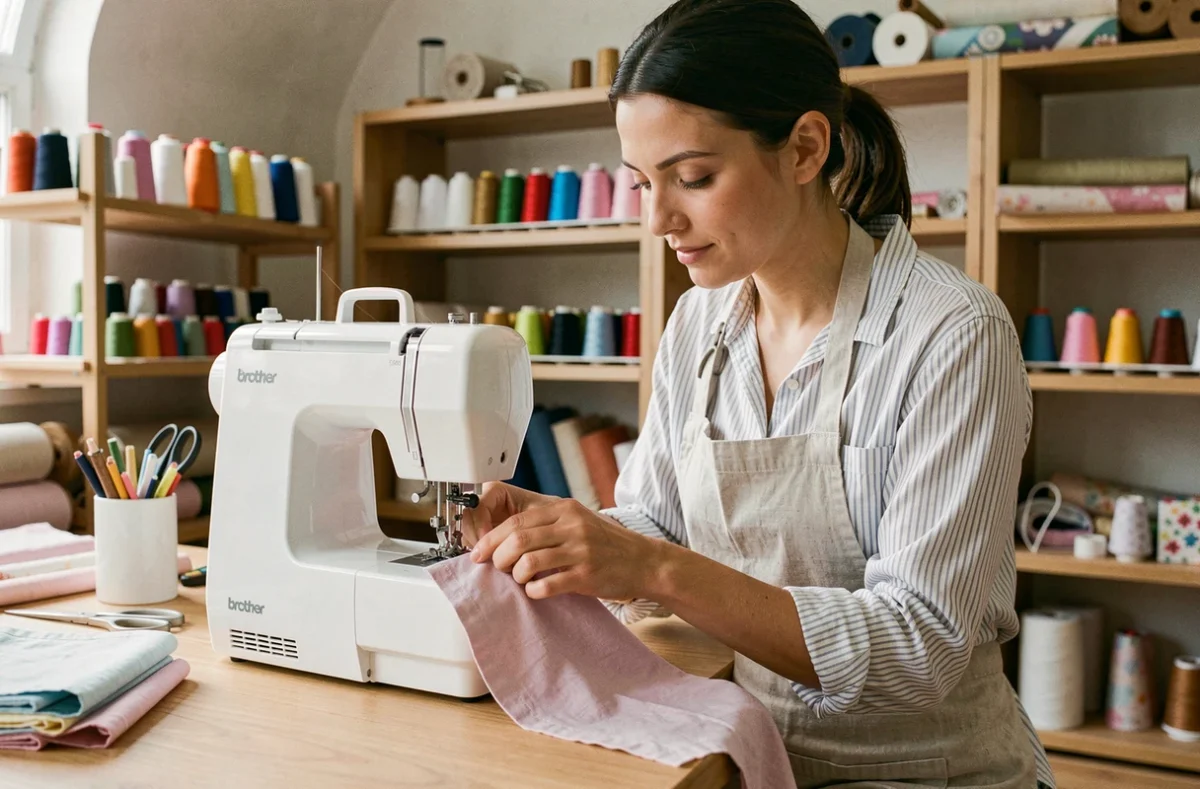
The Brother KE14, also known as Little Angel, holds a unique place in the Brother catalog. This mechanical machine is priced lower than most standard entry-level models and explicitly targets beginners and teenagers with its integrated finger guard, an accessory that no other manufacturer offers as standard. The market for beginner sewing machines remains dominated by models whose functions often exceed what a first-time user actually utilizes.
Brother KE14: what the finger guard changes (and does not change)
The finger guard on the KE14 is the only element that physically distinguishes it from a standard small mechanical machine. It attaches around the needle area and prevents fingers from getting too close to the mechanism while sewing. For a teenager or an adult anxious about the speed of the needle, this barrier reduces the tension of the initial sessions.
The protection has its limits. It does not eliminate the need for adult supervision when a child uses the machine, even from the recommended minimum age of 14. The finger guard is an aid, not a substitute for supervision. Presenting the KE14 as a standalone machine for children would be misleading.
A detailed test published on a site specializing in children’s sewing notes that the piece can obstruct visibility of the fabric under the presser foot. For precise seams or tight curves, some users end up removing the finger guard after a few weeks of practice, once the fear of the needle has disappeared. The technical sheet available on the Machine à Coudre website allows you to visualize the machine’s configuration with and without this accessory.
KE14 Settings: when the machine hinders learning
The Brother KE14 offers 14 pre-programmed stitch patterns. For assembling simple fabrics, hemming pants, or attaching a button, this number is more than sufficient. Most beginners do not use more than four or five stitches during their first months.
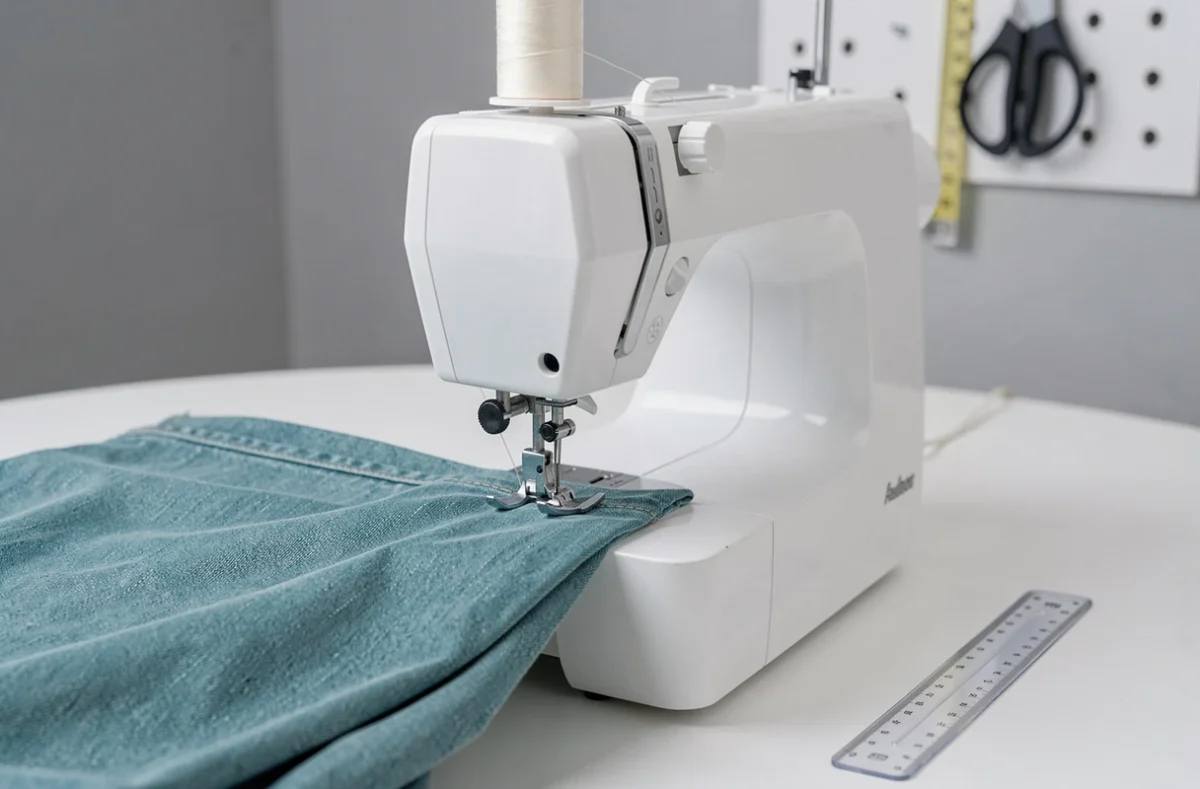
The problem lies elsewhere. The stitch length and width are not adjustable on this model. Each stitch is fixed in its factory settings. On a standard entry-level machine (including Brother’s higher range), these adjustments exist and allow for tailoring the sewing to the fabric: a stretchy jersey, a thick cotton, or a fine lining do not respond the same way to an identical stitch.
For a beginner sewing cotton pouches or simple accessories, the lack of adjustment is not a barrier. For someone looking to progress to fitted clothing or varied fabrics, this limitation becomes noticeable within a few months. Learning to sew precisely involves understanding the relationship between stitch adjustment and fabric behavior. The KE14 does not allow for developing this reflex.
When to consider a sewing machine above the KE14
The warning sign is simple: as soon as the fabric gathers, warps, or the stitch does not hold properly, and the only possible response is to change the fabric rather than adjust a setting, the machine has reached its limit. On a model with variable stitch length and width, this same problem can be resolved by turning a dial.
- Projects in jersey or stretchy fabric: the fixed straight stitch of the KE14 does not stretch, leading to brittle seams in use
- Invisible hems or decorative finishes: impossible to modify the width of the zigzag for a discreet finish
- Thick fabrics (denim, oilcloth): without length adjustment, the stitch being too short can perforate the fabric without properly assembling it
The KE14 adequately covers the first six to twelve months of a beginner working with light to medium fabrics. Beyond that, transitioning to an adjustable model becomes a logical investment.
Speed and power of the Brother KE14: data to take with caution
Several retailers display maximum speed figures for the KE14, but these values vary from site to site without a clearly identifiable manufacturer source. The advertised power is 50 W, a value consistent with a small mechanical machine intended for common fabrics.
In practice, speed is controlled by the pedal (classic rheostat). User feedback mentions a correct progression: it is possible to sew slowly, which reassures beginners. The machine does not “take off” abruptly when pressing the pedal, a common flaw in some low-end models from other brands.
Accessories and cost of upgrading the Brother KE14 machine
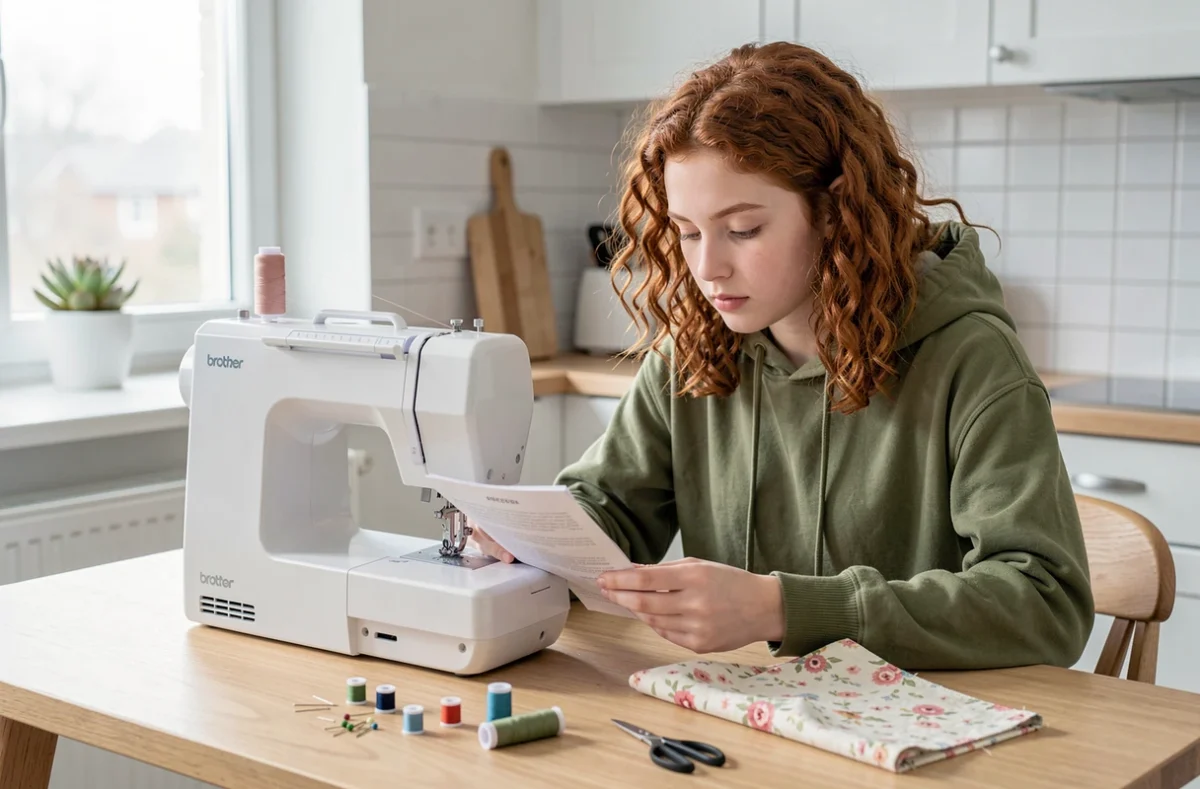
The KE14 comes with a basic kit: a few bobbins, a screwdriver, a seam ripper, and the finger guard. The extension table, useful for sewing wide pieces, is sold separately. This detail often goes unnoticed in product sheets and represents an additional cost to consider if projects exceed small accessories.
The standard presser foot is suitable for common operations. For attaching a zipper or performing buttonholes, the machine can handle these tasks within the limits of its 14 stitches. However, the optional compatible presser feet are fewer than on Brother’s higher ranges, which limits the possibilities for evolution without changing machines.
A coherent but narrow pricing position
The price of the KE14 hovers around a hundred euros depending on the retailers. At this price, it is positioned below standard entry-level mechanical machines which, for a few dozen euros more, offer stitch length and width adjustments. The choice boils down to a matter of priority: the safety of the finger guard and absolute simplicity on one side, technical evolution capability on the other.
The Brother KE14 fulfills its role as a first sewing machine to discover fundamental gestures. Its finger guard remains unique on the market and addresses a real concern of parents. Its technical limits become apparent as projects diversify, and transitioning to a more complete model then becomes a natural step rather than a failure of initial choice.